Second-Order Thinking: What Smart People Use to Outperform
Author: Farnam Street (fs.blog) Type: Mental model explainer
Summary
A thinking tool for examining long-term consequences. Moving past the immediate, obvious result of a decision to consider what happens after — and after that.
Howard Marks' Definition
From The Most Important Thing:
"First-level thinking is simplistic and superficial, and just about everyone can do it. All the first-level thinker needs is an opinion about the future, as in 'The outlook for the company is favorable, meaning the stock will go up.' Second-level thinking is deep, complex, and convoluted."
First-order thinking: Fast, easy, immediate. "I'm hungry → eat a chocolate bar."
Second-order thinking: Deliberate, systemic, temporal. "If I repeatedly eat chocolate bars when hungry → what does that lead to? → Better to eat something healthy."
First-level thinking is where everyone reaches the same conclusions. Extraordinary performance requires seeing what others can't see — which requires thinking past the first step.
How to Practice
- Always ask: "And then what?" — the single most useful prompt
- Think across time — 10 minutes, 10 months, 10 years
- Map 1st, 2nd, 3rd order consequences — write them out for important decisions
- For business decisions — how will employees, competitors, suppliers, regulators respond?
Key Insight
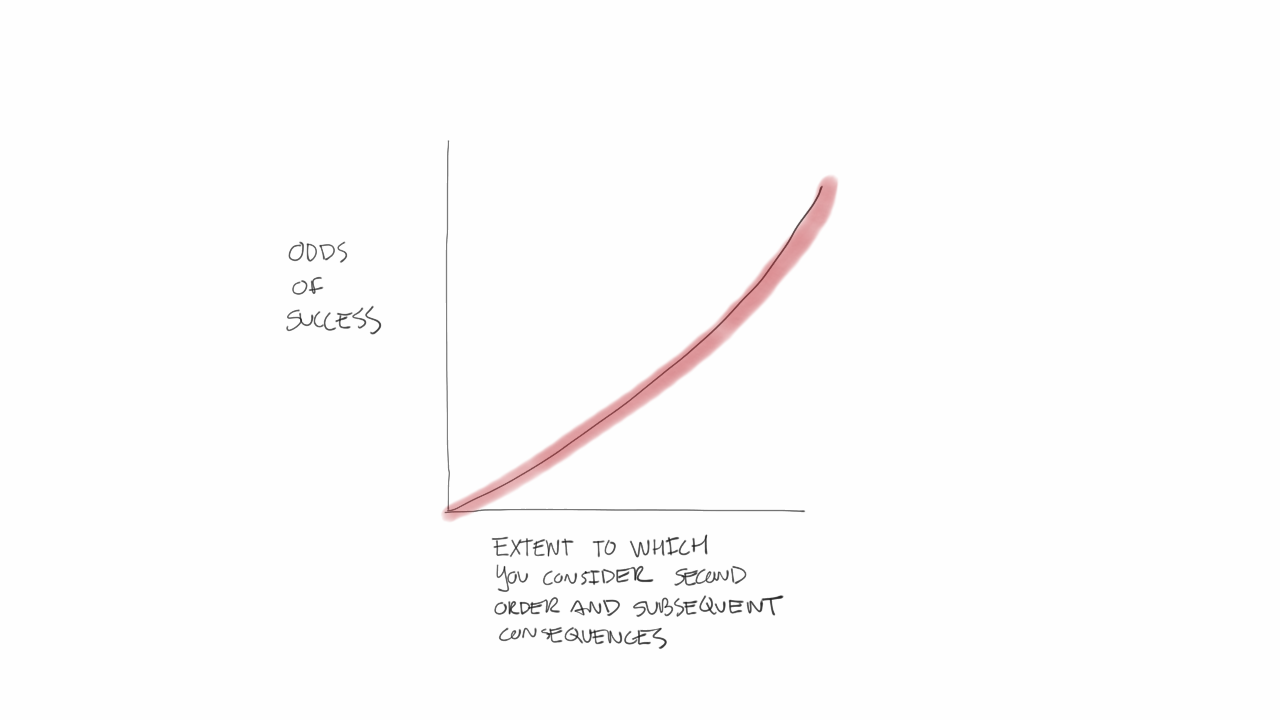
Many extraordinary things are first-order negative, second-order positive. If you only think at the first level, you'll avoid these opportunities — and face less competition from those who can't think past the immediate cost.
Second-order thinking is how you separate yourself. It's not easy — thinking in terms of systems, interactions, and time is hard — but it creates durable advantages.
Key Entities
- Howard Marks — investor, The Most Important Thing, coined "second-level thinking"