Source: BBC Bitesize — KS3 Computer Science Revision
Format: Short educational explainer (~600 words, UK secondary-school level)
Scope: Definition of decomposition, two worked examples (crime scene, app creation), brief coverage of division of labor
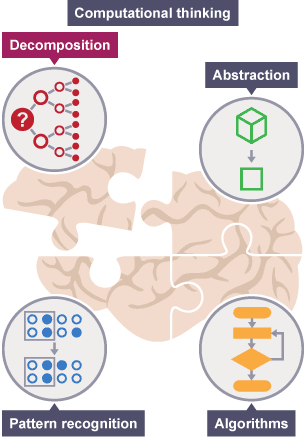
The article frames decomposition as one of the four cornerstones of Computer Science: breaking a complex problem or system into smaller parts that are more manageable and easier to understand. The core argument is that tackling many stages at once is harder than breaking a problem down and solving each piece individually — not just because the pieces are smaller, but because each can be examined in more detail.
The tooth-brushing example opens the piece to make the point that decomposition is already happening automatically in familiar tasks; it's only with new or complex tasks that conscious decomposition becomes necessary.
The two worked examples

Crime scene — the question "who committed this crime?" is decomposed into: what crime was committed, when, where, what evidence exists, whether there were witnesses, whether similar crimes have occurred recently. Each sub-question can be investigated independently.
App creation — a first-time app developer decomposes into: what kind of app, what it looks like, target audience, graphics, audio, software to build it, user navigation, testing method, and distribution channel. The list also makes division of labor visible: a friend handles graphics, another handles testing.
What to take forward
The source is introductory and thin on mechanism — it asserts decomposition is useful without explaining the recombination step or where decomposition can fail (integration errors, wrong grain size). The crime scene and app examples are both clean for teaching. The tooth-brushing example opens cleanly but the specific steps weren't captured in the raw.
Cross-links
- decomposition — synthesized concept page
- computational-thinking — decomposition as one of the four CT core elements