What Is Pattern Recognition — BBC Bitesize KS3
Source: BBC Bitesize — KS3 Computer Science Revision
Format: Short educational explainer (~600 words, UK secondary-school level)
Scope: Definition, cats example, two types of patterns (among/within problems), cake baking examples
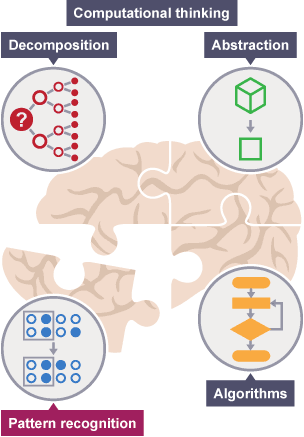
The article defines pattern recognition as finding the similarities or characteristics among the smaller problems produced by decomposition — patterns that help solve the complex original problem more efficiently. The definition is explicitly downstream of decomposition, which is the right framing.
The cats example

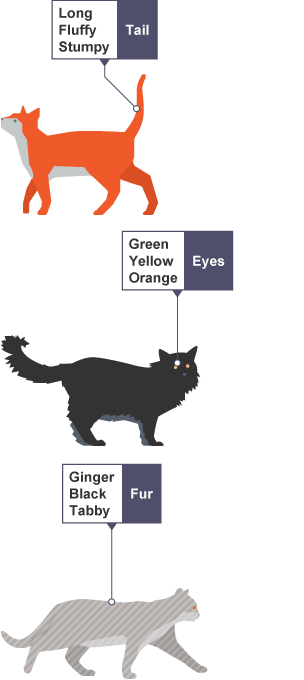
All cats share eyes, tails, and fur. Once you know this pattern, you can draw many cats without re-deriving what a cat looks like each time. The only things that vary are the specifics (eye color, tail length, fur pattern). The article makes an important negative case: if you don't look for the pattern, you might not realize all cats share these features — your drawn cats might not even look like cats. Missing the pattern doesn't just slow you down; it risks solving the problem incorrectly.
Two types of patterns
Patterns among different problems — things that are the same or similar across separate problems. Different cake recipes all require: a precise quantity of each ingredient, specific timing for adding each ingredient, and a defined baking duration. Once you've baked one cake, the structure of every cake recipe is familiar.
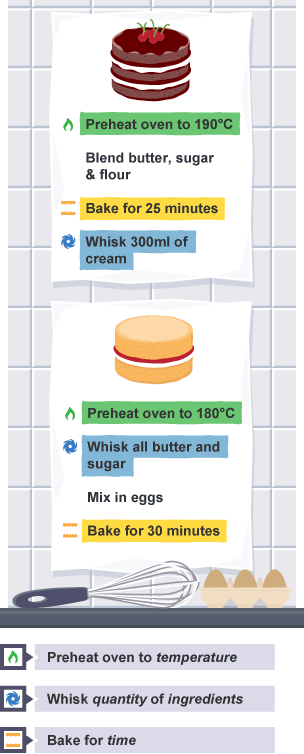
Patterns within a problem — recurring structure inside the sub-problems you've decomposed to. Within a single cake recipe, every ingredient follows the same sub-pattern: identify it and measure its amount. Once you know that sub-pattern, applying it to all ingredients is mechanical.
What to take forward
The two-type framework (among/within) is this source's clearest contribution. The cats example handles the "incorrect solution" risk well — it's a stronger argument for why you should look for patterns than just the efficiency argument. The cake examples are concrete. The article is light on what to do when no patterns are found (the QCAA video handles that better).
Cross-links
- pattern-recognition — synthesized concept page
- decomposition — pattern recognition follows decomposition; patterns are found among the decomposed pieces
- computational-thinking — pattern recognition as one of the four CT core elements