What Is Abstraction — BBC Bitesize KS3
What Is Abstraction — BBC Bitesize KS3
Source: BBC Bitesize, KS3 Computer Science Revision
Raw file: raw/What is abstraction - Abstraction - KS3 Computer Science Revision.md
Summary
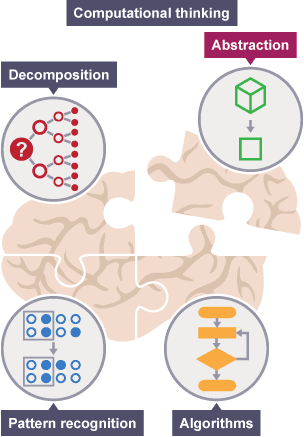
Abstraction is the process of filtering out the characteristics you don't need so you can concentrate on the ones you do. It follows pattern recognition in the CT sequence: once you've found which characteristics are shared, abstraction strips away the specific details to leave a general model. That model then tells you how to approach any instance of the problem, not just a specific one.
Key Points
Definition: Filtering out irrelevant characteristics and specific details, keeping only the general patterns that are necessary for solving the problem. The result is a model — a general idea of the problem.
The cats example (specific details):
- General characteristics all cats share: eyes, tail, fur, meowing, liking fish
- Specific characteristics: black fur, long tail, green eyes, love of salmon, loud meow
- To draw a basic cat, you need the generals (eyes, tail, fur), not the specifics (color, length, sound)
- Without abstraction you might believe all cats have long tails and short fur — a false constraint

The cats comparison (all types of cats):
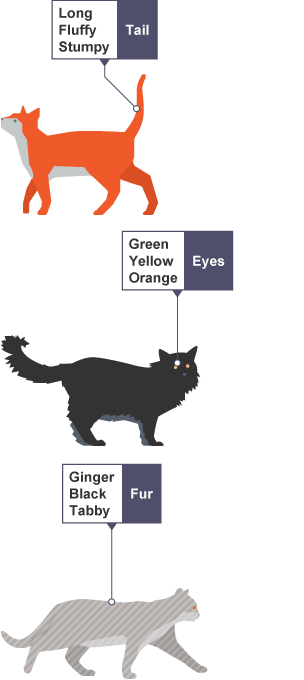
Different cats share the same general features (eyes, tails, fur) but the specifics vary. Abstracting produces a model cat that represents all cats, not any specific cat.
Cake baking — general vs. specific:
| General patterns | Specific details |
|---|---|
| We need to know a cake has ingredients | We don't need to know what those ingredients are |
| Each ingredient has a specified quantity | We don't need to know what that quantity is |
| Each cake needs a specified time to bake | We don't need to know how long the time is |
Model definition: A model is a general idea of the problem. It represents all instances, not a specific one. A model cake is any cake — not a specific sponge or fruit cake. From the model we can learn how to bake any cake.
Why it matters: Without abstraction, solutions become over-specified. You end up solving one specific case instead of the general problem. This is a source of incorrect solutions, not just inefficient ones.
Concepts
- abstraction — the core concept this source defines, adding the BBC "model" framing
- computational-thinking — abstraction is one of the four CT cornerstones
- pattern-recognition — pattern recognition identifies the shared characteristics; abstraction then filters out the specifics, keeping only the shared ones
- algorithm — the algorithm is designed for the abstracted model, not for a specific instance