What Is Computational Thinking — BBC Bitesize KS3
What Is Computational Thinking — BBC Bitesize KS3
Source: BBC Bitesize, KS3 Computer Science Revision
Raw file: raw/What is computational thinking - Introduction to computational thinking - KS3 Computer Science Revision.md
Summary
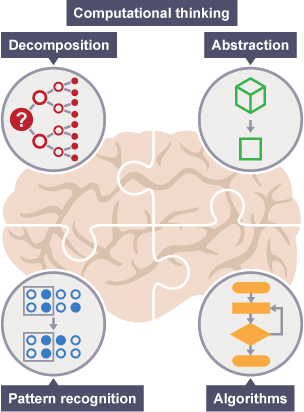
Computational thinking (CT) is the process of taking a complex problem, understanding it, and developing solutions that a computer, a human, or both can understand. The source introduces CT as four cornerstones — decomposition, pattern recognition, abstraction, and algorithms — and makes a clear distinction between CT (the planning) and programming (the execution).
Key Points
Definition: Taking a complex problem, breaking it into manageable parts, and developing possible solutions.
CT is not programming: "Computational thinking enables you to work out exactly what to tell the computer to do." Programming tells the computer how to do it; CT decides what to tell it. Neither thinking like a computer nor computing itself.
The four-cornerstone sequence in practice:
- Break the problem into smaller decisions (decomposition)
- Focus only on relevant details (abstraction)
- Apply knowledge of similar past problems (pattern recognition)
- Work out a step-by-step plan (algorithms)
CT vs programming analogy: Planning your route before leaving the house is like CT. Following the turn-by-turn directions is like programming.
Two worked examples:
Friends day out — deciding where to take a group with different preferences involves decomposing into: what to do, where to go, who wants what, past successes, money, weather, time. CT structures the decision; a computer could also help collect and analyse the data.
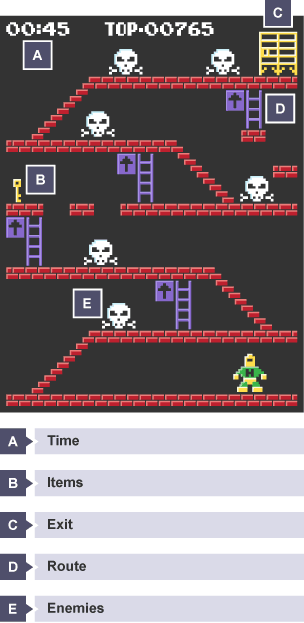
Videogame strategy — completing a level requires knowing: items to collect and time limits, the best exit route, enemy types and weak points. These questions must be answered before writing the game, and answered again each time you play it.
Table/leg analogy for the four elements: Each cornerstone is as important as the others. Like legs on a table — remove one and the table probably collapses.
Concepts
- computational-thinking — this source defines the four-cornerstone framework
- decomposition — first move in the CT sequence
- abstraction — filtering irrelevant detail, second move in the sequence
- pattern-recognition — recognizing similarities across past problems
- algorithm — final output of the CT process